Paper Details

Call For Papers
Volume 07, Issue 10
Frequency: 12 Issue per year
Paper Submission: Throughout the Month
Acceptance Notification: Within 2 days
Areas Covered: Multidisciplinary
Accepted Language: Multiple Languages
Journal Type: Online (e-Journal)
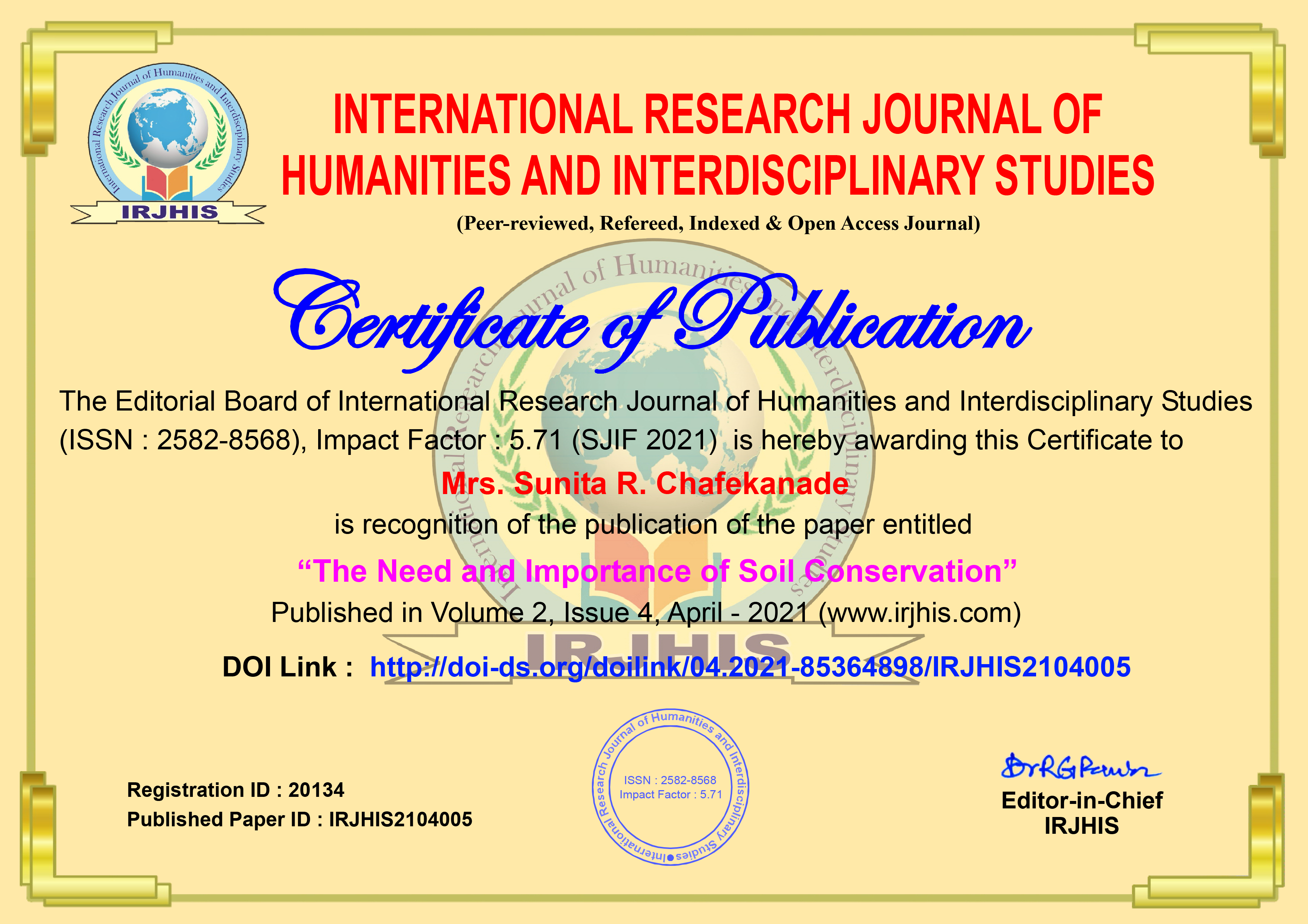
Sample Certificate
Announcement

Publish books with ISBN Number
- Edited Book
- Text Book
- Ph.D Thesis
- Conference Proceedings
ISSN Number:
2582-8568
Journal DOI No:
03.2021-11278686
Title:
Decolonising English education through Indian knowledge systems a critical study
Authors:
Cite this Article:
,
Decolonising English education through Indian knowledge systems a critical study, International Research Journal of Humanities and Interdisciplinary Studies (www.irjhis.com), ISSN : 2582-8568, Volume: 07, Issue: 05, Year: May 2026, Page No : 178-184,
Available at : http://irjhis.com/paper/IRJHIS2605020.pdf
Abstract:
In India the history of English education has been influenced by colonial policies which assigned English as a language of power, administration, modernity and social mobility. Alongside national and global opportunities that English affords, its colonial past has also created cultural alienation, linguistic privilege and reliance on Western knowledge structures. This paper critically explores the decolonising potential of Indian Knowledge Systems, through the lens of English education. Decolonisation is not about giving up English; it is about making English an authentic and culturally responsive, multilingual, inclusive and critically informed practice. The study delves into the colonial context of English education, the theoretical underpinning of decolonisation, the importance of IKS, and the significance of the National Education Policy 2020 in fostering Indian knowledge traditions. It believes that the English classrooms can be made places where learners connect with elements of Indian philosophy, literature, ethics, aesthetics, oral traditions, local histories, as well as communities' knowledge, and learn to communicate with the outside world. The paper also identifies challenges including tokenism, political misappropriation and inadequate teacher preparation and the potential for de-inclusion of marginalised knowledge traditions.
Keywords:
Decolonisation, English education, Indian Knowledge Systems, NEP 2020, multilingualism, colonial education
Publication Details:
Published Paper ID: IRJHIS2605020
Registration ID: 22402
Published In: Volume: 07, Issue: 05, Year: May 2026
Page No: 178-184
ISSN Number: 2582-8568
Download Full Paper: Click Here
Article Preview: