Paper Details

Call For Papers
Volume 07, Issue 10
Frequency: 12 Issue per year
Paper Submission: Throughout the Month
Acceptance Notification: Within 2 days
Areas Covered: Multidisciplinary
Accepted Language: Multiple Languages
Journal Type: Online (e-Journal)
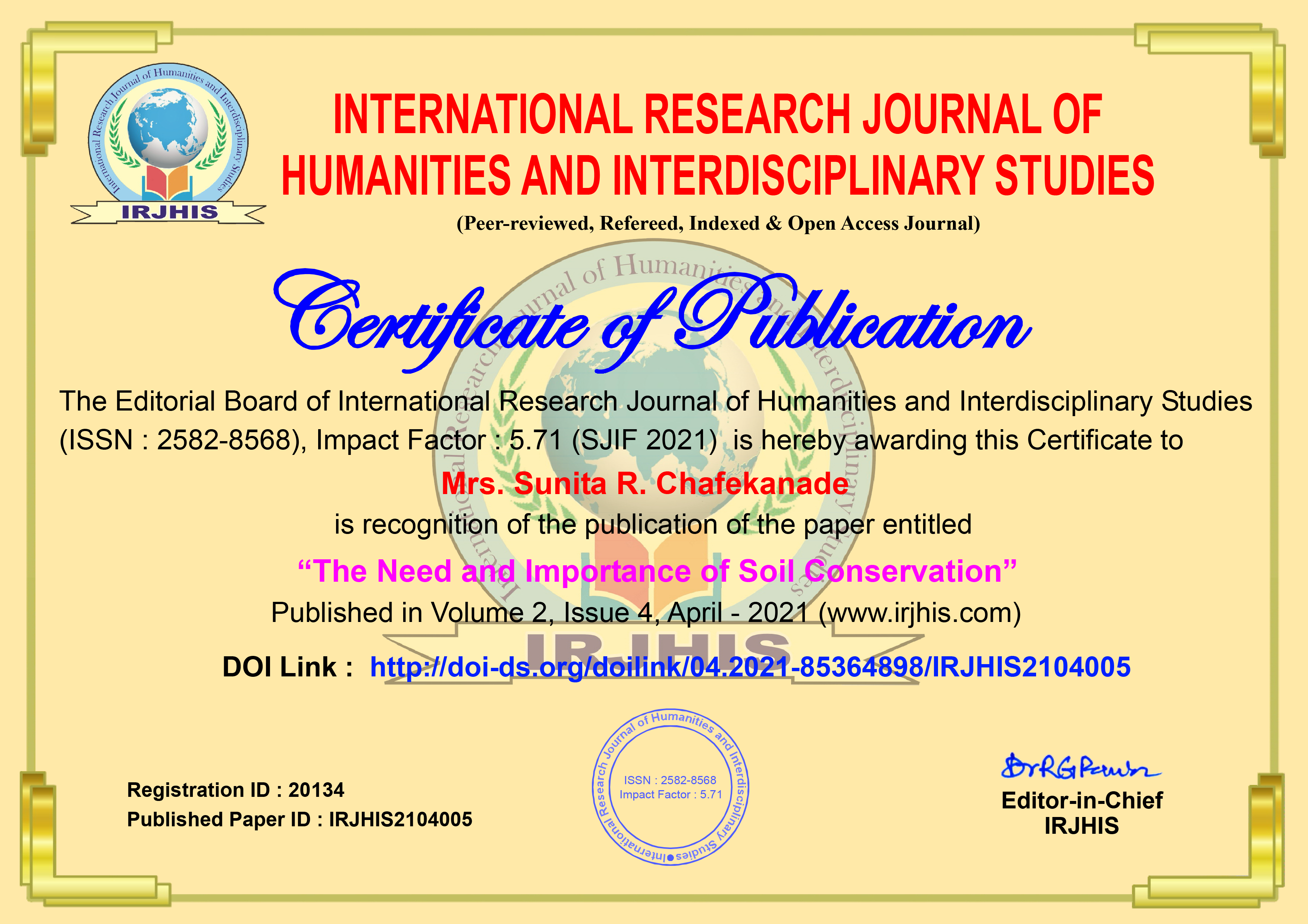
Sample Certificate
Announcement

Publish books with ISBN Number
- Edited Book
- Text Book
- Ph.D Thesis
- Conference Proceedings
ISSN Number:
2582-8568
Journal DOI No:
03.2021-11278686
Title:
Ecocriticism and Land Rights in Northeastern Literature
Authors:
Cite this Article:
,
Ecocriticism and Land Rights in Northeastern Literature, International Research Journal of Humanities and Interdisciplinary Studies (www.irjhis.com), ISSN : 2582-8568, Volume: 07, Issue: 05, Year: May 2026, Page No : 185-197,
Available at : http://irjhis.com/paper/IRJHIS2605021.pdf
Abstract:
This research paper explores the profound relationship between ecocriticism and land rights in the Northeastern Indian literature, with the focus given on how nature has such functioning as a landscape, but rather as a living organism, memory- bearer, and political witness. By conducting close analyses of some of the most important authors in Assam, Easterine Kire, Temsula Ao, Arupa Patangia Kalita, Mona Zote, and many more, the given study proves that the ecological consciousness is impossible to be taken out of context of the indigenous identity and land-based sovereignty. The Northeastern texts continually describe rivers, forests, hills, and sacred grove as cultural archives which create the shared memory and strength, and at the same time reveal the effects of colonial invasion, resource exploitation, militarization, displacement and ecological destruction. This paper claims that ecocriticism in Northeastern literature is by nature political as it becomes a response of the anthropocentrism and exploitative developmental patterns. Using eco-spiritual metaphors, animistic narratives, and native epistemologies, writers claim land as heritage, not as commodity and present moral, emotional and historical arguments in support of indigenous land rights. Finally, the paper also brings to the fore how the Northeastern literature offers a comprehensive ecological philosophy based on the principle of reciprocity, justice, and custodianship, which does not only criticize the violation of the environment, but also aims at a vision of a sustainable coexistence.
Keywords:
Ecocriticism, Indigenous Land Rights, Northeastern Literature, Environmental Memory, Eco-spirituality
Publication Details:
Published Paper ID: IRJHIS2605021
Registration ID: 22399
Published In: Volume: 07, Issue: 05, Year: May 2026
Page No: 185-197
ISSN Number: 2582-8568
Download Full Paper: Click Here
Article Preview: