Paper Details

Call For Papers
Volume 07, Issue 10
Frequency: 12 Issue per year
Paper Submission: Throughout the Month
Acceptance Notification: Within 2 days
Areas Covered: Multidisciplinary
Accepted Language: Multiple Languages
Journal Type: Online (e-Journal)
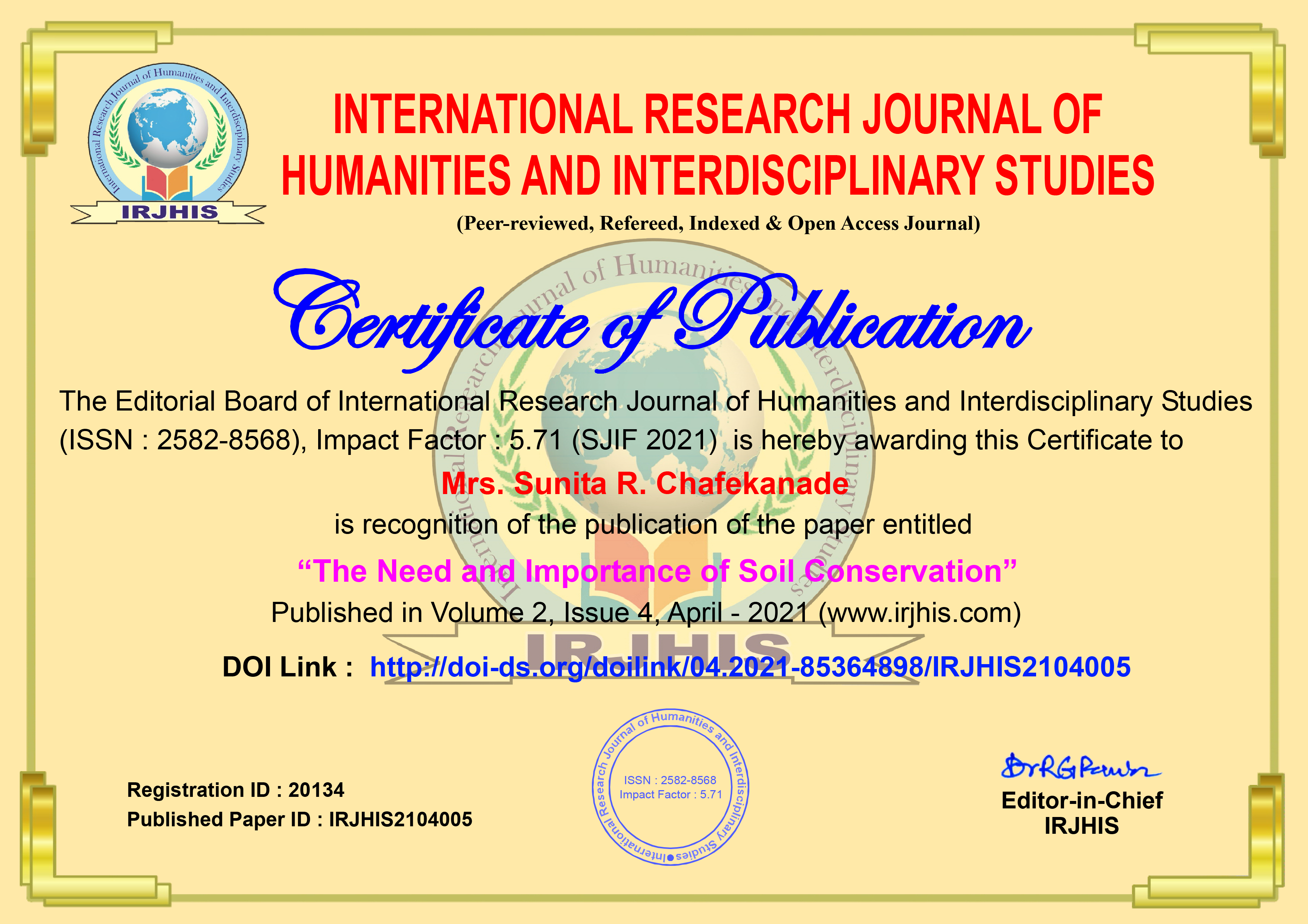
Sample Certificate
Announcement

Publish books with ISBN Number
- Edited Book
- Text Book
- Ph.D Thesis
- Conference Proceedings
ISSN Number:
2582-8568
Journal DOI No:
03.2021-11278686
Title:
Decolonizing English Literature through Indian Knowledge Systems: A Study of Select Indian English Texts
Authors:
Cite this Article:
,
Decolonizing English Literature through Indian Knowledge Systems: A Study of Select Indian English Texts, International Research Journal of Humanities and Interdisciplinary Studies (www.irjhis.com), ISSN : 2582-8568, Volume: 07, Issue: 05, Year: May 2026, Page No : 198-205,
Available at : http://irjhis.com/paper/IRJHIS2605022.pdf
Abstract:
The study explores the possibility of decolonizing of Indian English literature using the perspective of Indian Knowledge systems. In colonial education, the emphasis was placed on western literary models, European aesthetics and the colonial approach to the understanding of culture and as a result, English literary studies have grown in India to a large extent. This led to a neglect or marginalization of Indian philosophy, spiritual and oral traditions and ecology, and ethics. This study can be said to have called into question the idea that Indian English texts can be read only as a copy of the literary forms of the British. Rather, they are to be seen as creative expressions that take English as the language to create Indian cultural memories, indigenous knowledge, and local reality. The paper is focused on the three novels of Kanthapura by Raja Rao, The Guide by R. K. Narayan and The God of Small Things by Arundhati Roy. The following texts have been chosen as they cover various aspects of Indian life—village culture, spirituality, morality, caste, ecology, oral tradition and social change. The study examines these texts qualitatively, by looking at how they embody ideas of dharma, karma, spirituality, ecological consciousness, caste critique, and Indianized English. The paper also brings to focus the nature of Indian writers' assimilation of English for Indian rhythms, idioms, myths and cultural experiences. The study suggests Indian Knowledge Systems as a powerful alternative to a colonial and Eurocentric approach to the reading of Indian English literature, which renders literary studies more culturally grounded and intellectually open.
Keywords:
Decolonization, Indian Knowledge Systems, Indian English Literature, Postcolonialism, Indianized English, Dharma, Karma
Publication Details:
Published Paper ID: IRJHIS2605022
Registration ID: 22408
Published In: Volume: 07, Issue: 05, Year: May 2026
Page No: 198-205
ISSN Number: 2582-8568
Download Full Paper: Click Here
Article Preview: