Paper Details

Call For Papers
Volume 07, Issue 10
Frequency: 12 Issue per year
Paper Submission: Throughout the Month
Acceptance Notification: Within 2 days
Areas Covered: Multidisciplinary
Accepted Language: Multiple Languages
Journal Type: Online (e-Journal)
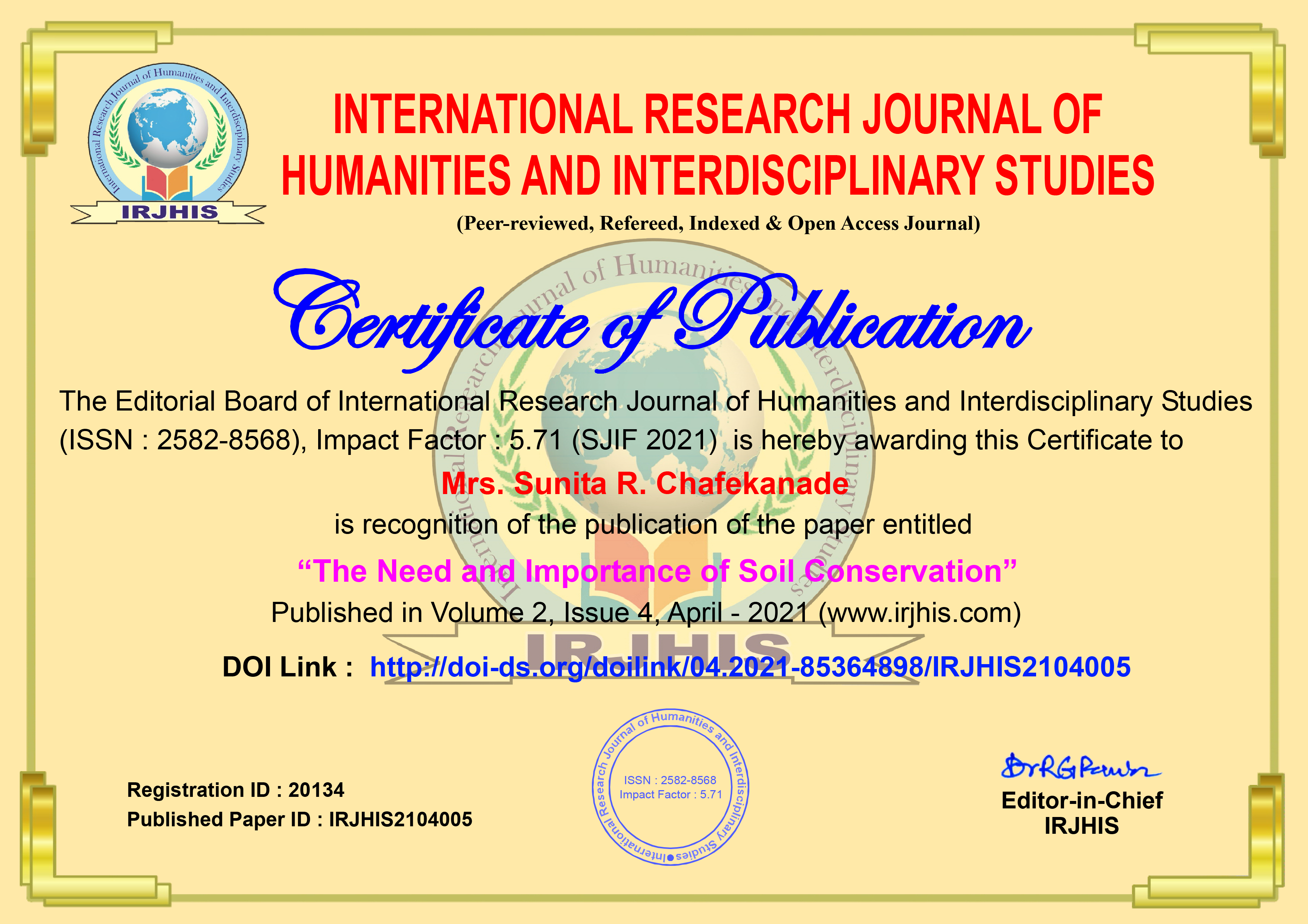
Sample Certificate
Announcement
Publish books with ISBN Number
- Edited Book
- Text Book
- Ph.D Thesis
- Conference Proceedings
ISSN Number:
2582-8568
Journal DOI No:
03.2021-11278686
Title:
Poverty and Economic Development in India: An Analysis of Government Reports and Secondary Data Sources
Authors:
Cite this Article:
,
Poverty and Economic Development in India: An Analysis of Government Reports and Secondary Data Sources, International Research Journal of Humanities and Interdisciplinary Studies (www.irjhis.com), ISSN : 2582-8568, Volume: 07, Issue: 06, Year: June 2026, Page No : 187-197,
Available at : http://irjhis.com/paper/IRJHIS2606021.pdf
Abstract:
Poverty and economic development are two phenomena which are closely related and influence greatly the socio-economic course of India. India has a history of tremendous economic growth over the last four decades, which is attributed to liberalization, industrialization and technology. Nevertheless, even with these achievements, the burden of poverty eradication over the long term is still significant and millions of citizens continue to endure income, education, healthcare, and access to basic amenities deprivation. This research paper explores the poverty patterns in India and researched on a combination of governmental publications, census and authoritative secondary publications and academic publications. It does not just look at the extent and trends of poverty but also the structural and socio-cultural factors that lead to deprivation and perpetuate them, such as landlessness, illiteracy, caste discrimination, gender inequality, and lack of access to financial and social services. The article also assesses the impact of economic growth on various social groups and finds that although urban and more affluent groups have gained disproportionately, rural populations, scheduled castes and tribes, and families headed by women remain in multidimensional poverty. Major policy interventions like the Mahatma Gandhi National Rural Employment Guarantee Act (MGNREGA), Public Distribution System (PDS), National Rural Livelihood Mission (NRLM) and other targeted welfare programmes are critically evaluated in terms of effectiveness in reducing poverty and enhancing human development indicators. The results suggest that even though India has managed to decrease extreme income poverty, structural and multidimensional deprivation remains a problem necessitating more inclusive and focused interventions. The paper ends with a policy advice that focuses on integrated development policies, human capital and social protection growth and gender sensitive policies to enhance equitable development and sustainable poverty reduction in all sectors of the society.
Keywords:
Poverty, economic development, India, multidimensional poverty, welfare programmes, secondary data, government reports, inequality.
Publication Details:
Published Paper ID: IRJHIS2606021
Registration ID: 22422
Published In: Volume: 07, Issue: 06, Year: June 2026
Page No: 187-197
ISSN Number: 2582-8568
Download Full Paper: Click Here
Article Preview: