Paper Details

Call For Papers
Volume 07, Issue 10
Frequency: 12 Issue per year
Paper Submission: Throughout the Month
Acceptance Notification: Within 2 days
Areas Covered: Multidisciplinary
Accepted Language: Multiple Languages
Journal Type: Online (e-Journal)
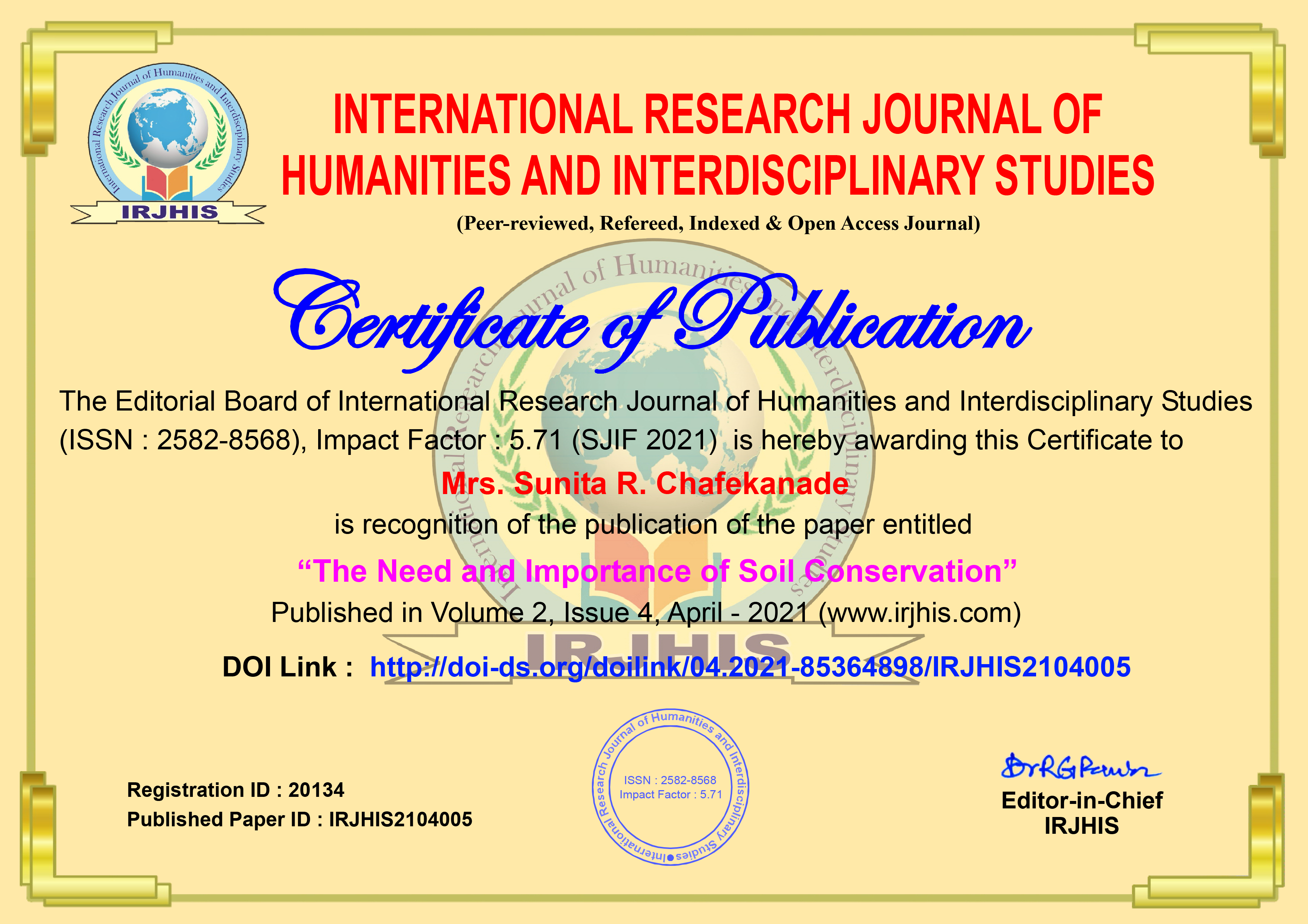
Sample Certificate
Announcement

Publish books with ISBN Number
- Edited Book
- Text Book
- Ph.D Thesis
- Conference Proceedings
ISSN Number:
2582-8568
Journal DOI No:
03.2021-11278686
Title:
Decolonising Nature: Indigenous Eco-Consciousness and the Rejection of the Anthropocene in Joy Harjo’s An American Sunrise and Conflict Resolution for Holy Beings
Authors:
Cite this Article:
,
Decolonising Nature: Indigenous Eco-Consciousness and the Rejection of the Anthropocene in Joy Harjo’s An American Sunrise and Conflict Resolution for Holy Beings, International Research Journal of Humanities and Interdisciplinary Studies (www.irjhis.com), ISSN : 2582-8568, Volume: 07, Issue: 06, Year: June 2026, Page No : 198-205,
Available at : http://irjhis.com/paper/IRJHIS2606022.pdf
Abstract:
Joy Harjo’s poetry collections, An American Sunrise and Conflict Resolution for Holy Beings, sit squarely at the intersection of Indigenous eco-consciousness and decolonial ecology. This paper explores that dynamic. Scholars often frame the Anthropocene as a universal human problem, but this Eurocentric view misses the mark. Instead, I argue that Harjo’s poetics correctly identify ecological collapse as a symptom of much more specific forces: settler colonialism, racial capitalism, and historical dispossession. Grounded in Mvskoke (Creek) epistemologies, her work tears down the artificial wall between nature and culture, treating the Earth not as a resource, but as a sentient web of relatives. By looking at themes like blood memory, the trauma of the Trail of Tears, and "trickster capitalism," this study shows how Harjo uses sonic kinship and the botanical imagination to work through historical wounds. Harjo’s vision for planetary healing demands a complete overhaul of environmental ethics, suggesting that true ecological justice simply cannot happen without Indigenous sovereignty and genuine respect for nature.
Keywords:
Indigenous Eco-Consciousness, Decolonial Ecology, Anthropocene, Joy Harjo, Native American Poetry, Environmental Justice
Publication Details:
Published Paper ID: IRJHIS2606022
Registration ID: 22429
Published In: Volume: 07, Issue: 06, Year: June 2026
Page No: 198-205
ISSN Number: 2582-8568
Download Full Paper: Click Here
Article Preview: