Paper Details

Call For Papers
Volume 07, Issue 10
Frequency: 12 Issue per year
Paper Submission: Throughout the Month
Acceptance Notification: Within 2 days
Areas Covered: Multidisciplinary
Accepted Language: Multiple Languages
Journal Type: Online (e-Journal)
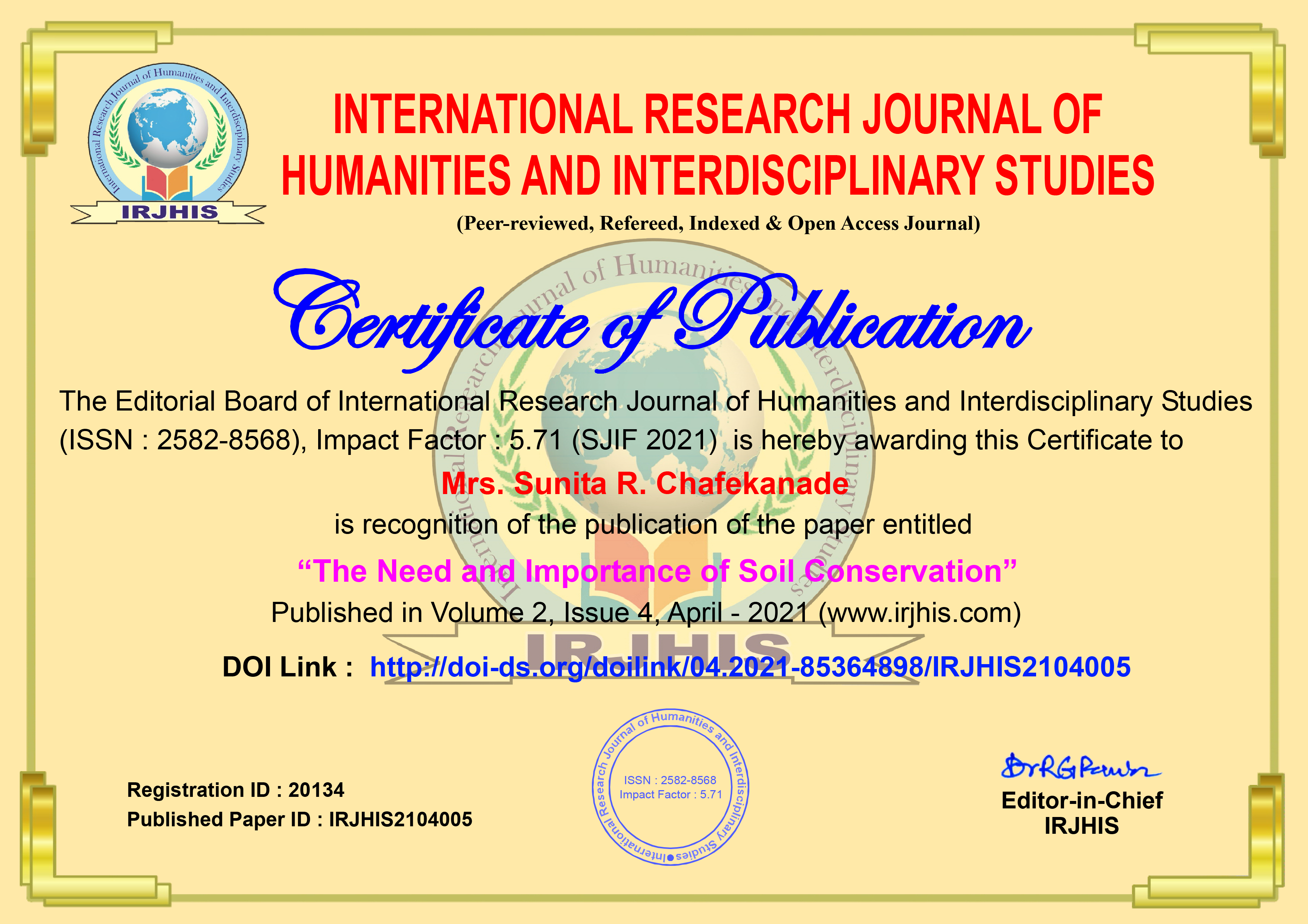
Sample Certificate
Announcement

Publish books with ISBN Number
- Edited Book
- Text Book
- Ph.D Thesis
- Conference Proceedings
ISSN Number:
2582-8568
Journal DOI No:
03.2021-11278686
Title:
Motivational Factors and Staff Performance: Empirical Evidence from the Manufacturing Sector
Authors:
Cite this Article:
,
Motivational Factors and Staff Performance: Empirical Evidence from the Manufacturing Sector, International Research Journal of Humanities and Interdisciplinary Studies (www.irjhis.com), ISSN : 2582-8568, Volume: 07, Issue: 06, Year: June 2026, Page No : 206-217,
Available at : http://irjhis.com/paper/IRJHIS2606023.pdf
Abstract:
Purpose: This study investigates the motivational factors that influence staff performance in the manufacturing sector, with empirical reference to Bajaj Electricals Ltd., a leading Indian manufacturing organisation. The research addresses a critical gap in understanding how both intrinsic and extrinsic motivational forces shape employee productivity and organisational effectiveness within an industrial context. Design/Methodology/Approach: A descriptive, quantitative research design was adopted. Primary data were collected via a structured, self-administered questionnaire distributed to a random sample of 66 employees across diverse age cohorts, experience levels, and functional roles. Secondary data were drawn from peer-reviewed journals, research reports, and academic literature. Descriptive statistical analysis was applied to examine response distributions across motivational constructs including salary, increment, working conditions, flexible timing, promotion, appreciation, advancement opportunity, recognition, decision-making authority, management style, career growth, and job security. Findings: Results demonstrate that appreciation for work performed (92.4% agreement), promotion based on merit (93.9%), and salary increments (97.0%) are the three strongest motivational drivers. A strong majority (90.9%) of respondents confirmed that incentives and benefits strongly influence their performance. Approximately 50% of employees indicated that a combination of financial and non-financial incentives is most motivating. Notably, working conditions and the absence of flexible working hours emerged as significant sources of demotivation. Practical Implications: Manufacturing organisations should adopt a holistic motivational strategy that integrates competitive financial rewards with non-monetary recognition, career development pathways, improved working conditions, and participatory management. HR practitioners should tailor motivational interventions to specific employee profiles as motivation is not uniform across the workforce. Originality/Value: This paper contributes to the motivation-performance literature in developing economies, specifically within the Indian manufacturing context, an underexplored domain relative to service-sector studies. The study offers actionable insights for HR managers and organisational leaders seeking to build a sustainably motivated workforce.
Keywords:
Employee Motivation, Staff Performance, Manufacturing Industry, Intrinsic Motivation, Extrinsic Motivation, Incentives, Bajaj Electricals
Publication Details:
Published Paper ID: IRJHIS2606023
Registration ID: 22426
Published In: Volume: 07, Issue: 06, Year: June 2026
Page No: 206-217
ISSN Number: 2582-8568
Download Full Paper: Click Here
Article Preview: