Paper Details

Call For Papers
Volume 07, Issue 10
Frequency: 12 Issue per year
Paper Submission: Throughout the Month
Acceptance Notification: Within 2 days
Areas Covered: Multidisciplinary
Accepted Language: Multiple Languages
Journal Type: Online (e-Journal)
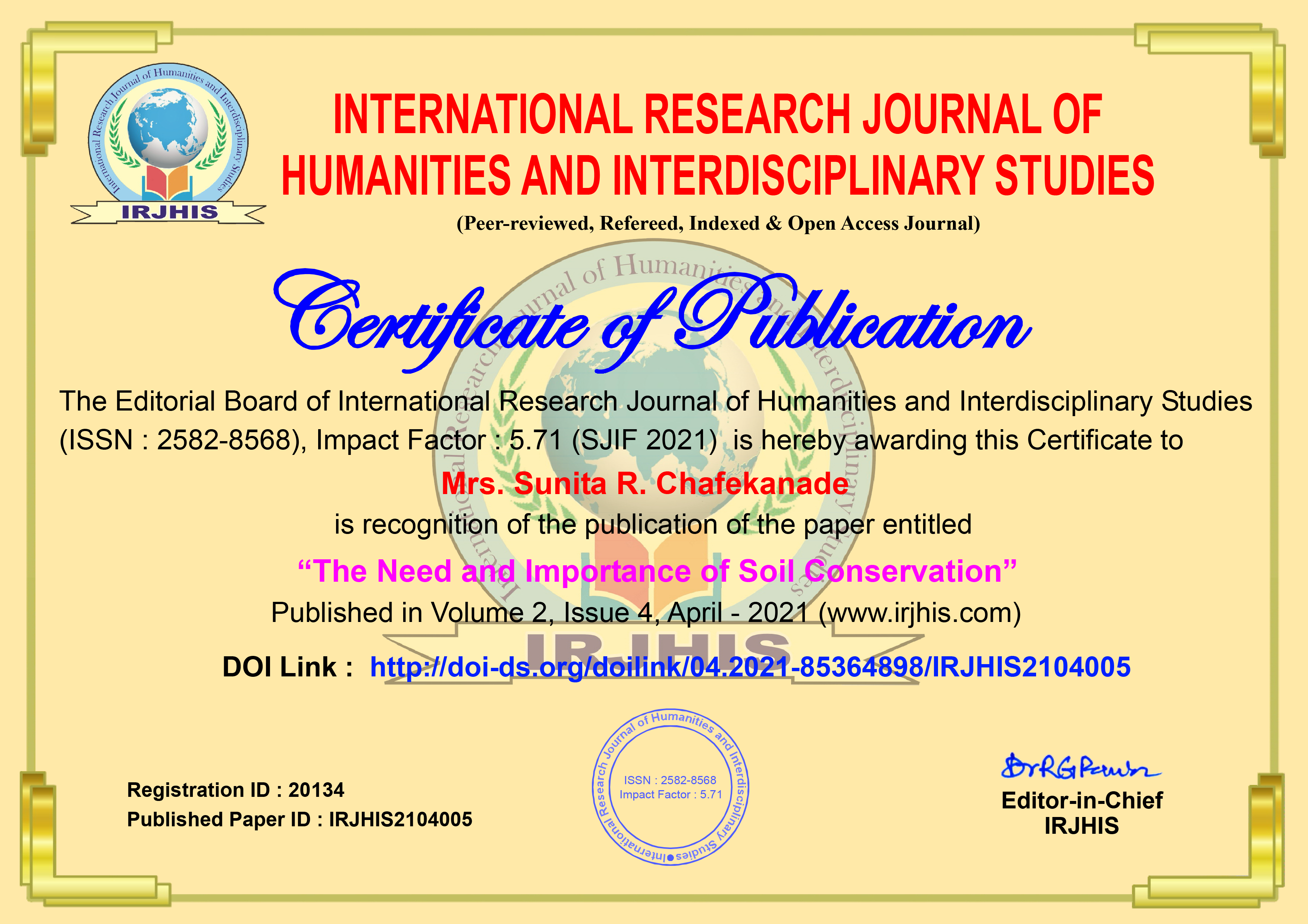
Sample Certificate
Announcement
Publish books with ISBN Number
- Edited Book
- Text Book
- Ph.D Thesis
- Conference Proceedings

ISSN Number:
2582-8568
Journal DOI No:
03.2021-11278686
Title:
The Biological Erasure of Belonging: A Critical Reading of Memory and Identity Crisis in M.G. Vassanji's Nostalgia
Authors:
Cite this Article:
,
The Biological Erasure of Belonging: A Critical Reading of Memory and Identity Crisis in M.G. Vassanji's Nostalgia , International Research Journal of Humanities and Interdisciplinary Studies (www.irjhis.com), ISSN : 2582-8568, Volume: 07, Issue: 07, Year: July 2026, Page No : 148-156,
Available at : http://irjhis.com/paper/IRJHIS2607016.pdf
Abstract:
This study provides a comprehensive critique of M.G. Vassanji’s speculative novel Nostalgia (2016), examining the complex intersection of state biopower, systematic neurological alteration, and the crisis of human subjectivity. While Vassanji is traditionally celebrated for his realistic depiction of the South Asian diaspora in East Africa, Nostalgia marks a significant generic evolution into futuristic writing. The narrative presents a dystopian reality in the affluent Global North where citizens receive near-immortality through neuro-regeneration, a process that requires the absolute deletion of their authentic historical past and the implantation of artificial, state-sanctioned childhood memories. This paper terms this medicalized amnesia the "biological erasure of belonging." We argue that this process serves as a violent administrative tool designed to strip marginalized individuals and migrants from the Global South ("Maskinia") of their historical identities, turning them into compliant consumers. Focusing on the psychological journeys of Dr. Frank Sina and Presley Smith, this paper explores how the return of repressed histories—manifested as "Leaked Memory Syndrome"—collapses the state's engineered harmony. By combining concepts of biopolitics with psychological trauma and the idea of the uncanny, we demonstrate that human identity cannot be easily re-programmed. The living body acts as an unpoliced archive that retains true history. Ultimately, this paper positions the novel as a timely critique of modern assimilation strategies that demand the destruction of cultural roots as the price for global citizenship.
Keywords:
Biopolitics, Memory, Studies, Identity Crisis, Postcolonial Dystopia, M.G. Vassanji, Somatic Memory, The Uncanny.
Publication Details:
Published Paper ID: IRJHIS2607016
Registration ID: 22463
Published In: Volume: 07, Issue: 07, Year: July 2026
Page No: 148-156
ISSN Number: 2582-8568
Download Full Paper: Click Here
Article Preview: