Paper Details

Call For Papers
Volume 07, Issue 09
Frequency: 12 Issue per year
Paper Submission: Throughout the Month
Acceptance Notification: Within 2 days
Areas Covered: Multidisciplinary
Accepted Language: Multiple Languages
Journal Type: Online (e-Journal)
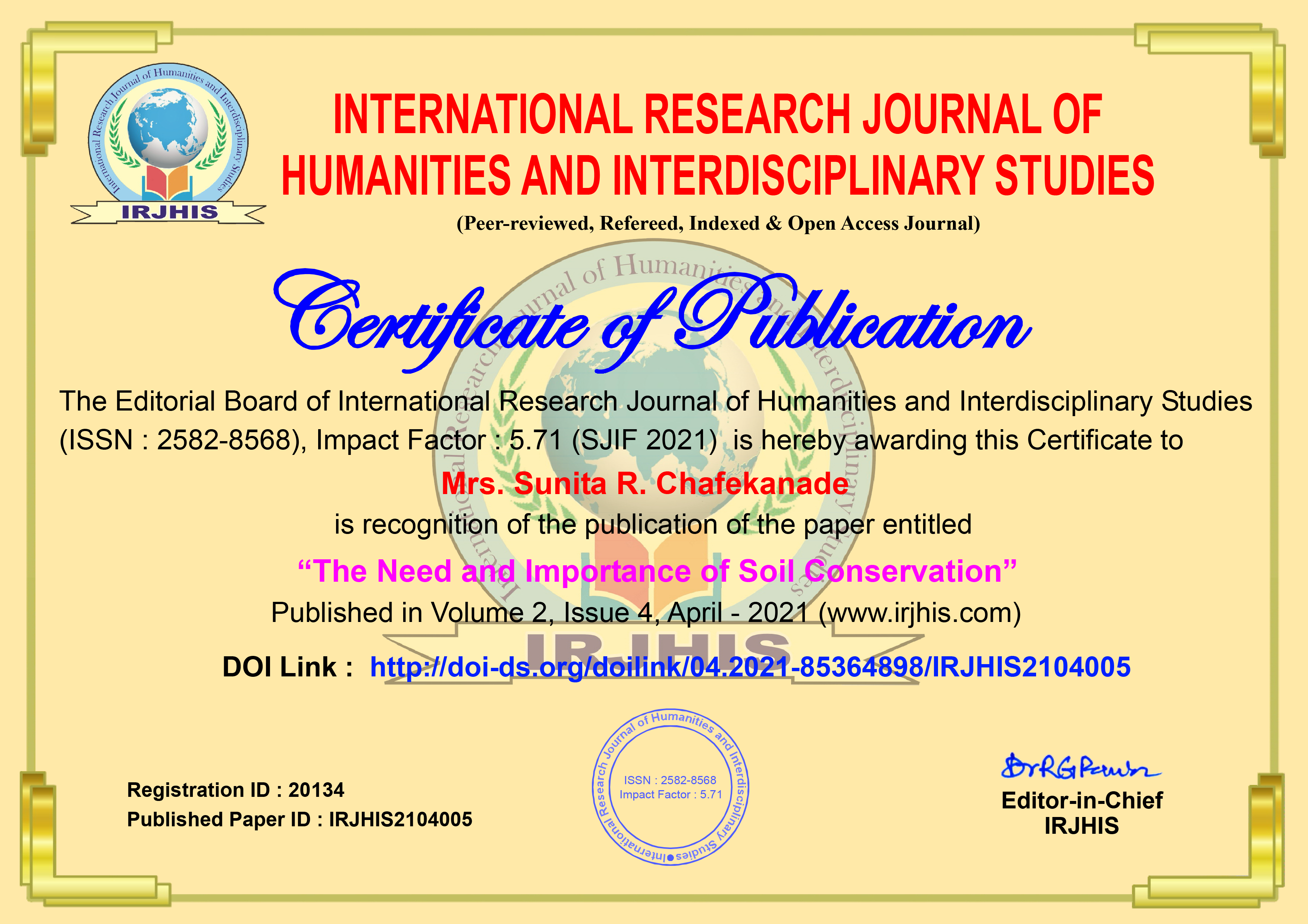
Sample Certificate
Announcement

Publish books with ISBN Number
- Edited Book
- Text Book
- Ph.D Thesis
- Conference Proceedings
ISSN Number:
2582-8568
Journal DOI No:
03.2021-11278686
Title:
Climate Change Impact on Mangrove Ecosystems of the Sundarbans: An Analytical Study of Ecological Vulnerability, Adaptation, and Conservation Needs
Authors:
Cite this Article:
,
Climate Change Impact on Mangrove Ecosystems of the Sundarbans: An Analytical Study of Ecological Vulnerability, Adaptation, and Conservation Needs, International Research Journal of Humanities and Interdisciplinary Studies (www.irjhis.com), ISSN : 2582-8568, Volume: 07, Issue: 09, Year: September 2026, Page No : 131-153,
Available at : http://irjhis.com/paper/IRJHIS2609015.pdf
Abstract:
Shared by India and Bangladesh, the Sundarbans are the largest contiguous mangrove-delta ecosystem in the world, forming a critical natural barrier against cyclones, storm surges, salinity flooding, and coastal erosion. This research paper looks at the climate-change impact on the Sundarbans mangroves through ecological vulnerability analysis, adaptation and conservation requirements. This research relies on authenticated secondary data taken from forest-cover assessments, official cyclone database, climate assessments and recent peer-reviewed remote-sensing literature. The analysis uses descriptive statistics, percentage changes, the linear trend method, the cyclone impact score and vulnerability index. The West Bengal mangrove cover data, including the Indian Sundarbans, indicate that the mangrove cover has had a net increase from 2,097.00 sq km in 2013 to 2,119.16 sq km in 2023. This shows a gain of 22.16 sq km (1.06 percent). 9 words is too short for paraphrasing. Remote-sensing studies have recently reported disturbances to the canopy as a result of cyclones. Also, shoreline loss, erosion hotspots destruction of habitats and declining higher forest-stocking and carbon classes. According to the vulnerability index, the highest-risk stressor is the rise of sea level, inundation by tidal, cyclone, storm surges, salinity intrusion and shoreline erosion. Due to forest damage and shoreline retreat, cyclone Amphan is the recent cyclone that caused disturbances in India. The findings indicate that Sundarbans is undergoing a dual condition of a slight increase in the mapped extent of mangroves, but a continuous degradation of ecoquality, forest structure and coastal stability. The paper says that conservation needs to move beyond area-based reporting and towards a full integrated monitoring of hydrology, salinity, sediment dynamics, species composition, blue carbon and community vulnerability. In the long term, we need to restore native species, zone the coast for climate, adapt to community regulations, reduce disaster risk and strengthen India-Bangladesh trans-boundary cooperation.
Keywords:
Climate change; Sundarbans; Mangrove ecosystems; Ecological vulnerability; Conservation adaptation
Publication Details:
Published Paper ID: IRJHIS2609015
Registration ID: 22500
Published In: Volume: 07, Issue: 09, Year: September 2026
Page No: 131-153
ISSN Number: 2582-8568
Download Full Paper: Click Here
Article Preview: