Paper Details

Call For Papers
Volume 07, Issue 11
Frequency: 12 Issue per year
Paper Submission: Throughout the Month
Acceptance Notification: Within 2 days
Areas Covered: Multidisciplinary
Accepted Language: Multiple Languages
Journal Type: Online (e-Journal)
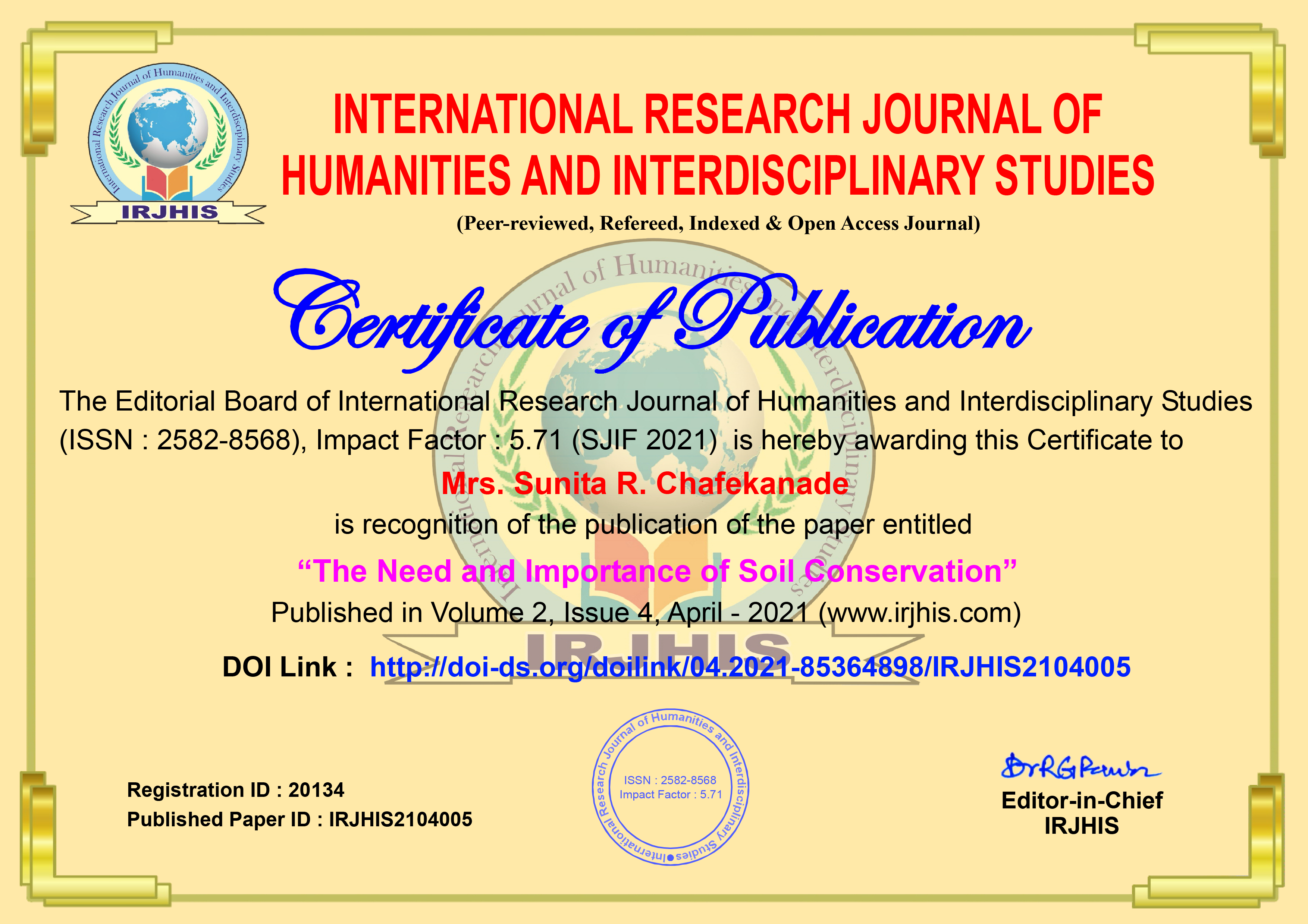
Sample Certificate
Announcement

Publish books with ISBN Number
- Edited Book
- Text Book
- Ph.D Thesis
- Conference Proceedings
ISSN Number:
2582-8568
Journal DOI No:
03.2021-11278686
Title:
Indian Knowledge Tradition in NEP 2020
Authors:
Cite this Article:
,
Indian Knowledge Tradition in NEP 2020, International Research Journal of Humanities and Interdisciplinary Studies (www.irjhis.com), ISSN : 2582-8568, Volume: 07, Issue: 11, Year: November 2026, Page No : 112-131,
Available at : http://irjhis.com/paper/IRJHIS2611011.pdf
Abstract:
The National Education Policy (NEP) 2020 represents a significant transformation in the Indian education system, emphasizing holistic development, multidisciplinary learning, Indian languages, cultural rootedness, critical thinking, creativity, ethics, and lifelong learning. One of the important dimensions of the policy is the recognition and integration of the Indian Knowledge Tradition (IKT) into contemporary education. Indian Knowledge Tradition encompasses a wide range of intellectual, scientific, philosophical, artistic, linguistic, medical, ecological, technological, and social knowledge systems that have evolved in the Indian subcontinent over centuries. It includes the knowledge contained in the Vedas, Upanishads, Buddhist and Jain traditions, Indian philosophical schools, Ayurveda, Yoga, mathematics, astronomy, linguistics, literature, architecture, arts, agriculture, environmental practices, and diverse forms of indigenous and community knowledge. The present research paper examines the conceptual relationship between NEP 2020 and Indian Knowledge Tradition and analyses its significance for contemporary education. The study is descriptive and analytical in nature and is based primarily on secondary sources, including policy documents, books, academic literature, institutional reports, and scholarly studies. The paper explores the possibilities of integrating Indian knowledge into curriculum development, teaching-learning processes, teacher education, higher education, research, innovation, and community engagement. It argues that the meaningful integration of Indian Knowledge Tradition should not be limited to the celebration of cultural heritage but should promote critical inquiry, evidence-based understanding, interdisciplinary learning, ethical development, and contextual knowledge. The paper further identifies challenges such as inadequate teacher preparation, limited learning resources, lack of systematic documentation, linguistic barriers, and the possibility of uncritical presentation of traditional claims. Suggestions are provided for curriculum development, teacher training, digital documentation, interdisciplinary research, and community participation. The paper concludes that NEP 2020 provides a valuable policy framework for reconnecting Indian education with its intellectual and cultural heritage while maintaining scientific temper, inclusivity, academic rigor, and global relevance.
Keywords:
Indian Knowledge Tradition, NEP 2020, Indian Education, Multidisciplinary Education, Indian Languages, Holistic Learning
Publication Details:
Published Paper ID: IRJHIS2611011
Registration ID: 22499
Published In: Volume: 07, Issue: 11, Year: November 2026
Page No: 112-131
ISSN Number: 2582-8568
Download Full Paper: Click Here
Article Preview: