Paper Details

Call For Papers
Volume 07, Issue 10
Frequency: 12 Issue per year
Paper Submission: Throughout the Month
Acceptance Notification: Within 2 days
Areas Covered: Multidisciplinary
Accepted Language: Multiple Languages
Journal Type: Online (e-Journal)

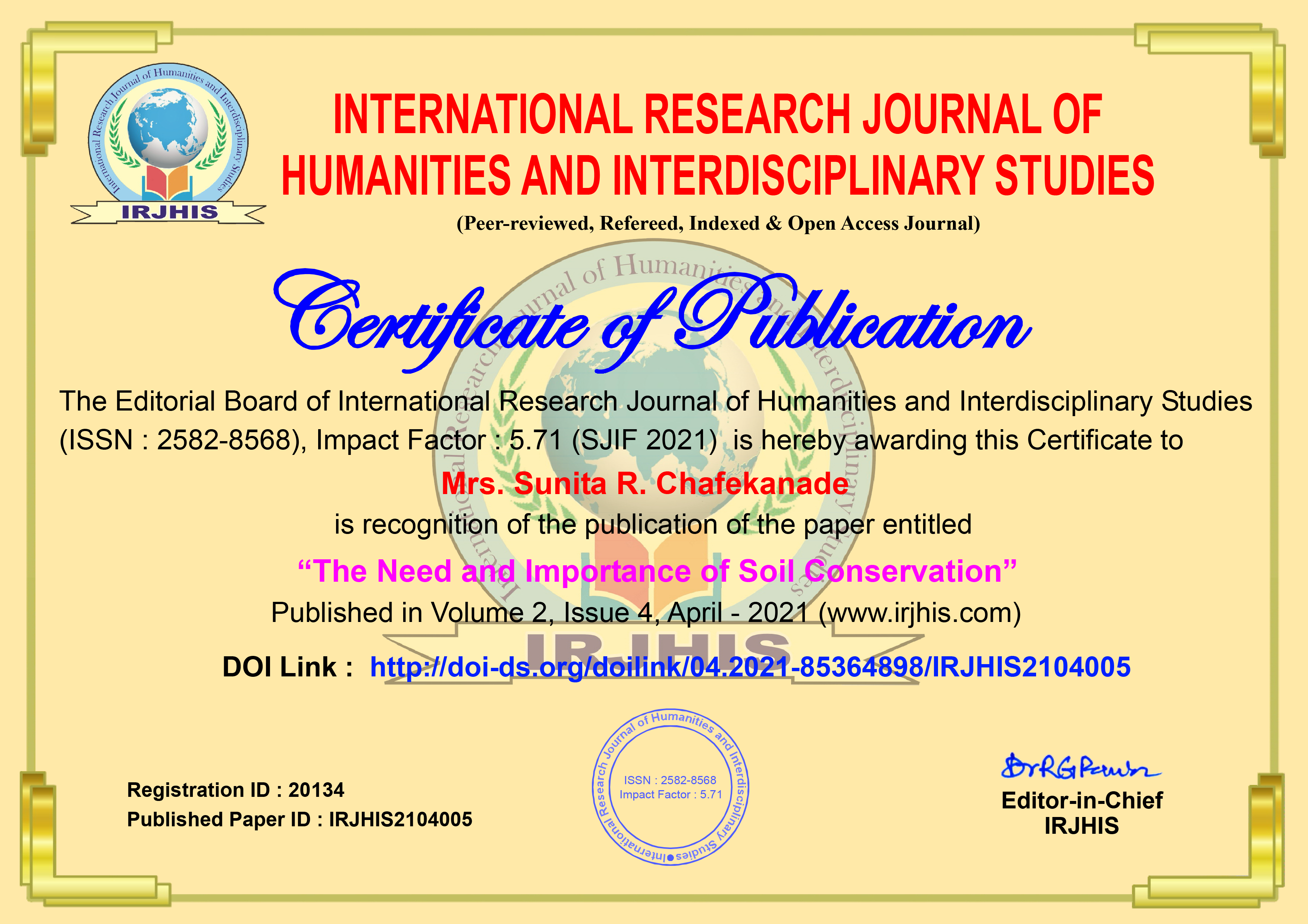
Sample Certificate
Announcement
Publish books with ISBN Number
- Edited Book
- Text Book
- Ph.D Thesis
- Conference Proceedings
ISSN Number:
2582-8568
Journal DOI No:
03.2021-11278686
Title:
An Analytical Study of the Phased Processes of Reading Development in School Education with Special Reference to the National Curriculum Framework for School Education 2023
Authors:
Cite this Article:
,
An Analytical Study of the Phased Processes of Reading Development in School Education with Special Reference to the National Curriculum Framework for School Education 2023, International Research Journal of Humanities and Interdisciplinary Studies (www.irjhis.com), ISSN : 2582-8568, Volume: 07, Issue: 05, Year: May 2026, Page No : 22-31,
Available at : http://irjhis.com/paper/IRJHIS2605004.pdf
Abstract:
Abstract- The objective of education is not limited merely to the transmission of information or facts; rather, its fundamental goal is to foster understanding, analytical skills, imagination, and a critical perspective among students. Within this holistic educational process, reading skills occupy a particularly central role. Reading is, in reality, not merely the mechanical act of pronouncing words; rather, it is a cognitive faculty involving the comprehension of ideas, the assimilation of emotions, and the structuring of knowledge. The National Education Policy 2020 and the National Curriculum Framework for School Education 2023 (NCFSE 2023) reinforce the premise that, to render education truly effective, it is imperative to position reading at the very core of school education. The present research study examines the staged processes of reading development within school education as outlined in the National Curriculum Framework for School Education 2023 based on the six stages of reading development propounded by the renowned educationist J.S. Chall (1983). According to Chall, reading development is a continuous, sequential, and cognitive process that commences with the ‘pre-reading’ stage and extends through to the “construction and reconstruction of perspectives.” This article provides a detailed analysis of each stage- pre-reading, initial reading, fluent reading, reading for new knowledge, reading from multiple perspectives, and the construction and reconstruction of perspectives and aligns them with the corresponding school levels (primary, middle, secondary and higher secondary). This research paper emphasizes the necessity, at every stage of school education, to guide students toward attaining a reading proficiency level that is commensurate with their cognitive and linguistic development. At the primary level, priority should be accorded to fostering oral language skills, phonemic awareness, and print awareness among children; conversely, at the secondary level, students should be guided toward engaging in multi-perspectival analysis and critical thinking. At the higher secondary level, students independently formulate ideas, utilize reading as a medium for intellectual discourse, and prepare themselves to assume the role of active, discerning, and responsible citizens. This research paper further discusses the pivotal role played by both teachers and textbook authors in the process of reading development. Teachers must possess a comprehensive understanding of every stage of reading and be cognizant of the specific types of activities, examples, and contexts that can be employed to render the reading experience meaningful for students. Textbook authors and content creators must pay special attention to linguistic simplicity, contextual relevance, diversity, and inclusivity. Furthermore, reading can be presented as a creative process through the implementation of pedagogical strategies such as activity-based learning, the utilization of visual aids, the incorporation of questions designed to foster higher-order thinking skills, and interactive writing. Ultimately, this study underscores that if reading is perceived as a process for fostering critical thinking and creativity and is robustly integrated into the framework of school education. It will not only enhance students' academic achievements but also enable them to evolve into lifelong learners, independent thinkers, and responsible citizens.
Keywords:
National Curriculum Framework for School Education 2023, National Education Policy 2020, Reading Development, Pre-reading, Initial reading, Fluent Reading, Activity-based Learning.
Publication Details:
Published Paper ID: IRJHIS2605004
Registration ID: 22369
Published In: Volume: 07, Issue: 05, Year: May 2026
Page No: 22-31
ISSN Number: 2582-8568
Download Full Paper: Click Here
Article Preview: