Paper Details

Call For Papers
Volume 07, Issue 10
Frequency: 12 Issue per year
Paper Submission: Throughout the Month
Acceptance Notification: Within 2 days
Areas Covered: Multidisciplinary
Accepted Language: Multiple Languages
Journal Type: Online (e-Journal)
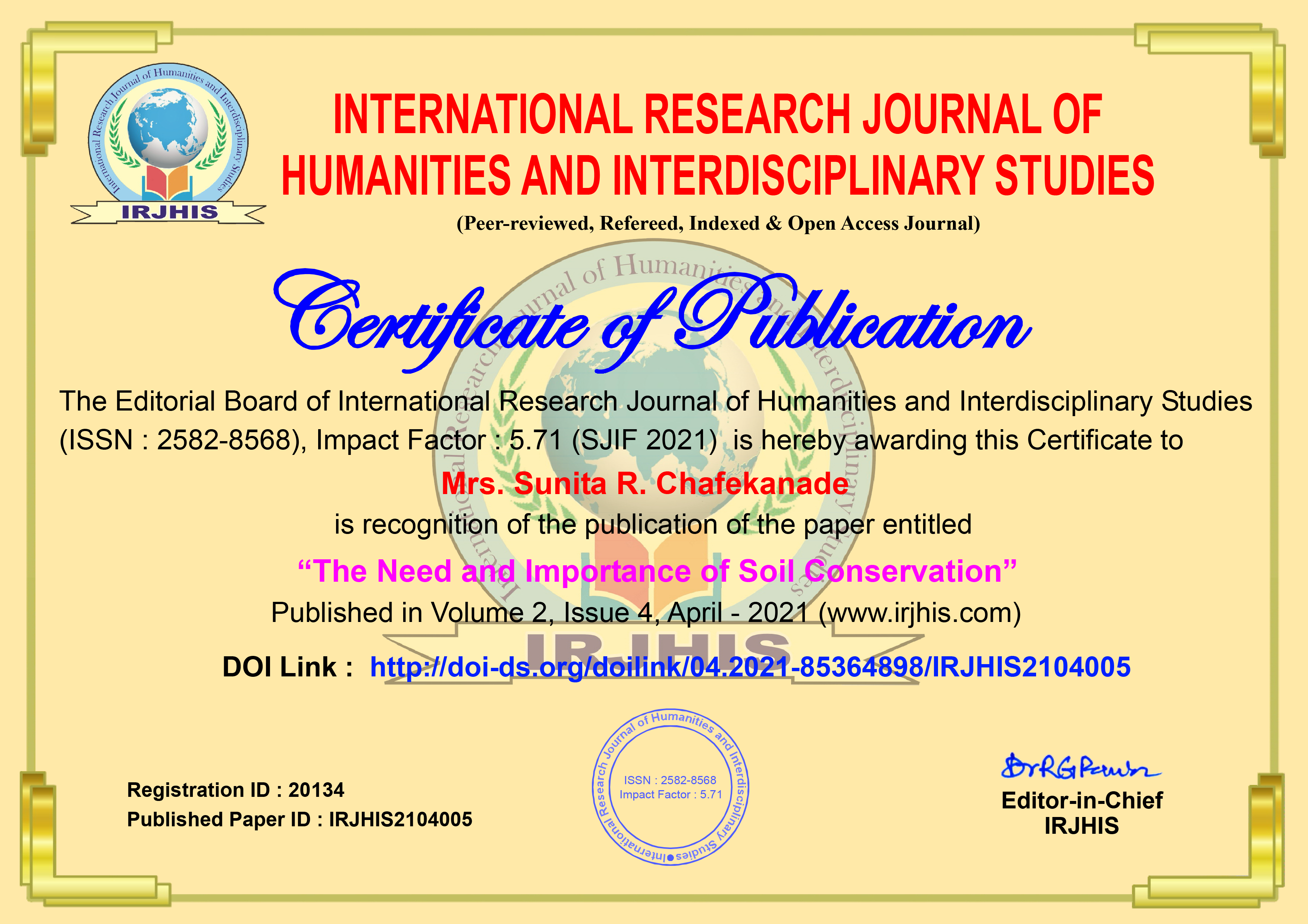
Sample Certificate
Announcement

Publish books with ISBN Number
- Edited Book
- Text Book
- Ph.D Thesis
- Conference Proceedings

ISSN Number:
2582-8568
Journal DOI No:
03.2021-11278686
Title:
Ecological Overshoot as a Structural Driver of Twenty-First Century Global Crises: A Social Science Analysis with Reference to India
Authors:
Cite this Article:
,
Ecological Overshoot as a Structural Driver of Twenty-First Century Global Crises: A Social Science Analysis with Reference to India, International Research Journal of Humanities and Interdisciplinary Studies (www.irjhis.com), ISSN : 2582-8568, Volume: 07, Issue: 07, Year: July 2026, Page No : 194-201,
Available at : http://irjhis.com/paper/IRJHIS2607021.pdf
Abstract:
The twenty-first century is marked by interconnected crises including climate change, biodiversity loss, water scarcity, food insecurity, migration pressures and widening inequality. While these challenges are often addressed separately, this paper argues that many are linked through a deeper systemic condition: ecological overshoot, wherein human demand on ecosystems exceeds the Earth's regenerative capacity. Drawing on the IPAT identity, Kaya decomposition and planetary boundaries literature, the study develops a social science framework for understanding overshoot as a structural driver that interacts with governance failures, unequal distribution and technological pathways. Using secondary data from international agencies and Indian policy sources, the paper evaluates global trends and examines India as a critical case of demographic transition, rapid urbanization, rising consumption and ecological stress. India illustrates the paradox of development under constraint: declining fertility and economic modernization coexist with groundwater depletion, air pollution, land degradation and infrastructure deficits. The paper argues that overshoot should be understood not as a single cause of all crises, but as a threat multiplier that intensifies existing vulnerabilities. It proposes a multidimensional policy response centred on voluntary population stabilization, women’s empowerment, circular economy transitions, efficient urban planning, ecological pricing reforms, renewable energy expansion and social protection systems. The study concludes that durable peace, prosperity and social justice require development strategies that bring human demand back within ecological limits while safeguarding equity.
Keywords:
Ecological Overshoot; Sustainability; Climate Change; Demography; Development Policy
Publication Details:
Published Paper ID: IRJHIS2607021
Registration ID: 22457
Published In: Volume: 07, Issue: 07, Year: July 2026
Page No: 194-201
ISSN Number: 2582-8568
Download Full Paper: Click Here
Article Preview: